

Radar Sensors Market to Reach USD 109.22 Billion by 2035, Expanding at a Robust 15.2% CAGR Over Forecast Period
Radar Sensors Market
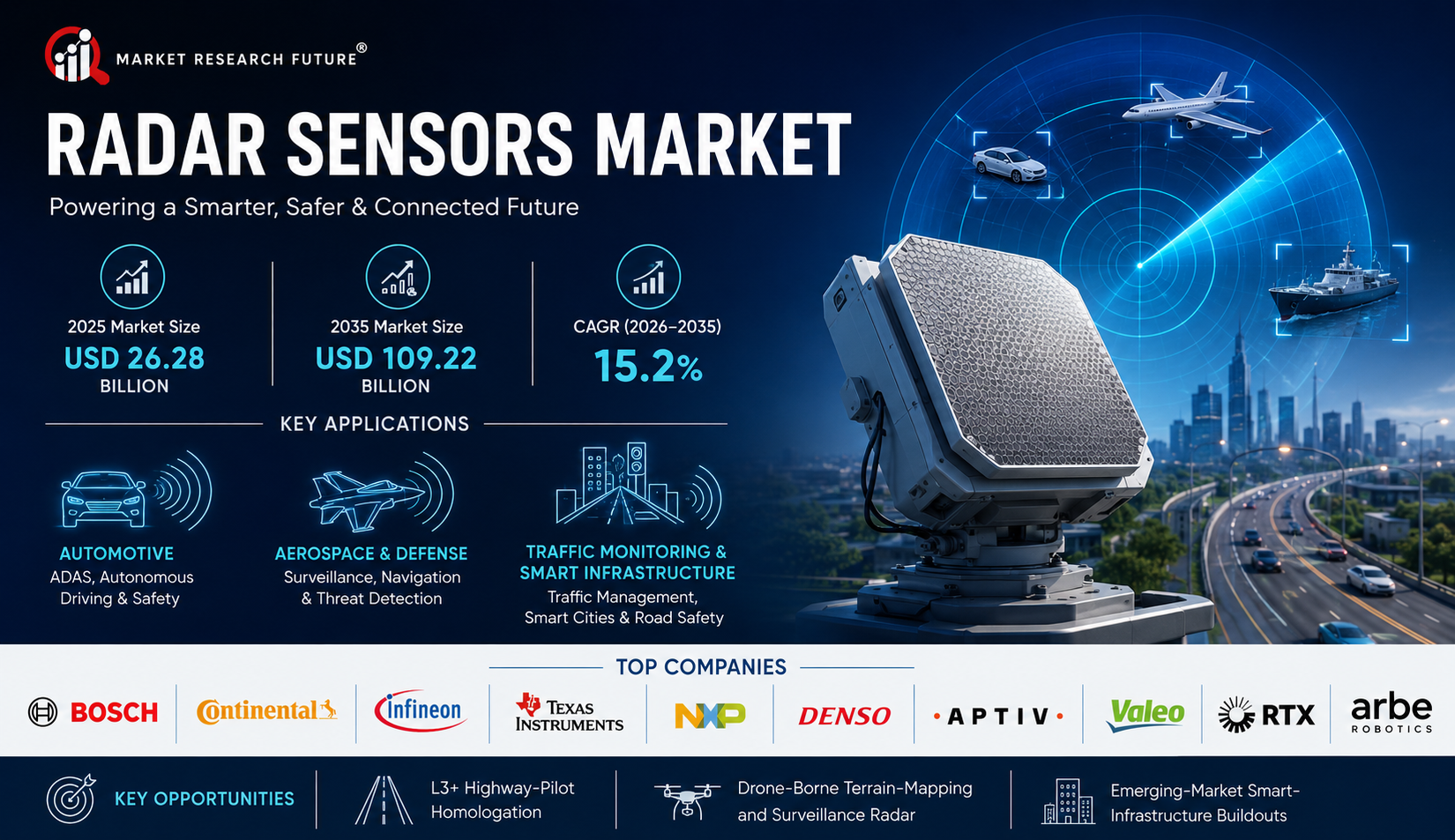
Global radar sensors market is projected to grow from USD 26.28 billion in 2025 to USD 109.22 billion by 2035, registering a CAGR of 15.2% during the 2026–2035.
NEW YORK, NY, UNITED STATES, July 20, 2026 /EINPresswire.com/ -- The global radar sensors market is undergoing a transformative expansion, supported by rapid technological advancements and increasing deployment across automotive, defense, and smart infrastructure ecosystems.Radar sensors have evolved from traditional detection systems into highly sophisticated sensing solutions capable of enabling autonomous systems, enhancing safety, and supporting real-time decision-making. The increasing convergence of artificial intelligence, advanced signal processing, and high-frequency radar technologies is redefining their application scope across industries.
Market Latest Trends:
The radar sensors market is currently shaped by several transformative trends that are redefining performance standards and expanding application areas.
One of the most prominent trends is the shift toward high-frequency radar bands, particularly the 77–81 GHz spectrum. This frequency range is becoming the industry standard for automotive applications due to its ability to deliver higher resolution, improved object detection, and enhanced reliability in adverse weather conditions. As a result, automotive manufacturers are rapidly integrating these radar systems into advanced driver assistance systems (ADAS) and autonomous driving platforms.
Request Sample of Report: https://www.marketresearchfuture.com/sample_request/4159
Another key trend is the integration of digital MIMO (Multiple Input Multiple Output) radar technology. Digital MIMO enables superior angular resolution and object discrimination compared to traditional radar systems. This advancement is particularly crucial for applications such as autonomous driving, drone navigation, and industrial automation, where precise environmental mapping is essential.
The miniaturization and cost optimization of radar modules is also accelerating adoption across consumer and industrial applications. Semiconductor advancements are enabling compact radar chips with lower power consumption, making them suitable for integration into devices such as smart home systems, wearable technologies, and robotics.
Additionally, the rise of radar-based sensing for non-contact applications, including vital sign monitoring and human presence detection, is expanding the market beyond traditional sectors. These capabilities are gaining traction in healthcare, security, and smart building environments.
Finally, the convergence of radar with AI and edge computing is enabling real-time analytics and decision-making. This integration enhances the performance of radar systems in complex environments, making them indispensable in next-generation mobility and smart infrastructure solutions.
Market Drivers:
The growth trajectory of the radar sensors market is strongly influenced by multiple high-impact drivers.
Automotive ADAS regulatory mandates are one of the most significant contributors, accounting for approximately 3.5% of the overall CAGR impact. Governments and regulatory bodies worldwide are enforcing stricter vehicle safety standards, encouraging the adoption of radar-based safety features such as adaptive cruise control, collision avoidance, and blind-spot detection.
Defense modernization programs, particularly the deployment of Active Electronically Scanned Array (AESA) radar systems, contribute approximately 2.8% to market growth. These systems offer enhanced detection capabilities, improved reliability, and greater operational flexibility, making them essential for modern military applications.
The migration toward 77–81 GHz radar architectures contributes around 2.4% to CAGR, driven by the need for higher accuracy and improved performance in automotive and industrial applications.
Smart city initiatives and traffic infrastructure development account for nearly 2.0% of market expansion, as governments invest in intelligent transportation systems, traffic monitoring, and urban safety solutions.
Additional drivers include the advancement of autonomous vehicle technologies (1.8%), industrial safety radar for collaborative robots (1.5%), and weather radar system upgrades (1.2%), all contributing to sustained market growth across regions.
Market Opportunities:
The radar sensors market presents substantial opportunities for innovation and expansion.
One major opportunity lies in Level 3 and above (L3+) autonomous driving homologation, where radar sensors play a critical role in enabling safe and reliable autonomous operations. As regulatory approvals progress, demand for high-performance radar systems is expected to surge.
The use of radar in drone-based terrain mapping and surveillance is another emerging opportunity. Radar’s ability to operate effectively in low-visibility conditions makes it highly valuable for applications such as environmental monitoring, defense reconnaissance, and disaster management.
Furthermore, smart infrastructure development in emerging economies offers significant growth potential. Investments in intelligent transportation systems, urban surveillance, and connected infrastructure are driving demand for radar-based solutions in regions such as the Middle East, Asia-Pacific, and Latin America.
Recent Developments:
August 2022 – Infineon Technologies introduced the AURIX TC4x radar processor family, incorporating an integrated hardware security module. This innovation reduced radar electronic control unit (ECU) component count by approximately 30%, enhancing system efficiency and lowering overall costs.
October 2025 – Infineon launched the BGT60TR13C 60 GHz radar transceiver capable of detecting human presence and monitoring vital signs through walls at a distance of up to 10 meters. This development highlights the expanding role of radar sensors in healthcare and smart living applications.
Profiles of Top Companies:
The radar sensors market is characterized by the presence of leading global players focusing on innovation, strategic partnerships, and product development.
Robert Bosch GmbH - A dominant player in automotive radar systems, Bosch focuses on advanced ADAS and autonomous driving technologies. Its radar solutions are widely adopted across global automotive platforms.
Continental AG - Continental specializes in high-performance radar sensors for vehicle safety and automation. The company emphasizes scalable radar platforms to meet evolving automotive requirements.
Infineon Technologies AG - Infineon is a key semiconductor provider offering radar chipsets and system solutions. Its focus on high-frequency radar and integrated processing solutions positions it as a technology leader.
Texas Instruments Incorporated - Texas Instruments provides radar sensor chipsets with integrated signal processing capabilities, enabling compact and efficient radar systems for automotive and industrial applications.
NXP Semiconductors N.V. - NXP offers advanced radar processing platforms and RF solutions, supporting automotive safety systems and secure connectivity.
Denso Corporation - Denso focuses on automotive radar systems, particularly for ADAS and autonomous driving applications, leveraging strong partnerships with global automakers.
Aptiv PLC - Aptiv delivers advanced sensing and perception systems, including radar technologies, supporting next-generation mobility solutions.
Valeo SA - Valeo is a pioneer in automotive radar systems, particularly in short- and medium-range radar technologies used in ADAS applications.
Raytheon Technologies (RTX) - A major player in defense radar systems, RTX focuses on advanced military radar technologies, including AESA systems for surveillance and combat applications.
Arbe Robotics Ltd. - Arbe Robotics specializes in high-resolution imaging radar solutions, targeting autonomous driving and advanced perception systems.
Regional Analysis:
The radar sensors market demonstrates strong regional dynamics influenced by technological adoption, regulatory frameworks, and investment trends.
Asia-Pacific holds the largest market share, accounting for 37.0% in 2025. The region’s dominance is driven by rapid adoption of automotive ADAS technologies, strong semiconductor manufacturing capabilities, and increasing defense investments, particularly in AESA radar systems.
North America represents 27.5% of the market, supported by defense modernization initiatives and the widespread adoption of ADAS in commercial and passenger vehicles. Government investments in advanced radar technologies further strengthen the region’s position.
Europe accounts for 22.8% market share, driven by stringent vehicle safety regulations such as Euro NCAP requirements and ongoing investments in intelligent transportation systems under initiatives like Horizon Europe.
South America, with a 5.5% share, is witnessing gradual growth, primarily supported by applications in airport surveillance and agricultural drone radar systems.
Middle East & Africa is expected to register the fastest growth, with a CAGR of 16.2% during 2026–2035. Large-scale smart city projects, such as NEOM, and increased investments in border surveillance systems are key growth drivers in this region.
Segment Analysis:
The radar sensors market is segmented across multiple dimensions, reflecting its diverse application landscape.
By Type - The market is divided into imaging radar and non-imaging radar. Imaging radar is gaining prominence due to its ability to generate high-resolution environmental maps, making it essential for autonomous driving and advanced surveillance applications. Non-imaging radar continues to be widely used in traditional detection and monitoring systems.
By Frequency Band - Radar sensors operate across various frequency bands, including less than 10 GHz, 24 GHz, 60–64 GHz, 77–81 GHz, and 94 GHz and above. The 77–81 GHz band dominates automotive applications due to its superior performance, while the 60–64 GHz band is increasingly used for indoor sensing and short-range applications.
By Range - Based on detection range, the market is categorized into short-range, medium-range, and long-range radar. Short-range radar is commonly used for parking assistance and blind-spot detection, while medium- and long-range radar are essential for adaptive cruise control and highway driving applications.
By Technology - Technological segmentation includes pulsed radar, FMCW (Frequency Modulated Continuous Wave), and digital MIMO radar. FMCW radar is widely adopted due to its ability to provide accurate distance and velocity measurements, while digital MIMO radar represents the next generation of high-resolution sensing technology.
By End-User - The market serves multiple end-user industries, including:
Automotive – The largest segment, driven by ADAS and autonomous vehicle adoption.
Aerospace and Defense – Focused on surveillance, navigation, and combat systems.
Traffic Monitoring & Smart Infrastructure – Emerging segment driven by smart city initiatives and intelligent transportation systems.
Conclusion:
The radar sensors market is poised for significant expansion, driven by advancements in sensing technologies, increasing adoption across industries, and strong regulatory support for safety and automation. With a projected CAGR of 15.2% and market value expected to surpass USD 109 billion by 2035, the industry presents substantial opportunities for stakeholders.
As innovation continues to reshape the capabilities of radar systems, companies that invest in high-frequency technologies, AI integration, and scalable solutions will be best positioned to capitalize on the evolving market landscape.
Browse More Reports:
Military Radar Systems Market
https://www.marketresearchfuture.com/reports/military-radar-systems-market-1413
Naval Radar System Market
https://www.marketresearchfuture.com/reports/naval-radar-system-market-43590
Security Surveillance Radar Market
https://www.marketresearchfuture.com/reports/security-surveillance-radar-market-33364
Sagar Kadam
Market Research Future
+1 628-258-0071
sales@marketresearchfuture.com
Legal Disclaimer:
EIN Presswire provides this news content "as is" without warranty of any kind. We do not accept any responsibility or liability for the accuracy, content, images, videos, licenses, completeness, legality, or reliability of the information contained in this article. If you have any complaints or copyright issues related to this article, kindly contact the author above.
