

Texas Stands Apart as ACA Enrollment Falls Elsewhere

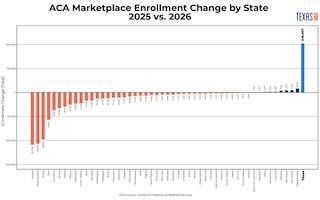
ACA Marketplace Enrollment Change by State
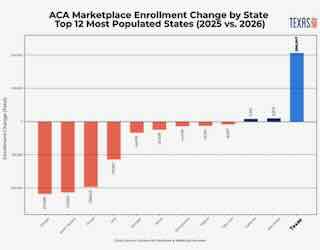
ACA Marketplace Enrollment Change by State_ Top 12 Most Populated
Final plan selection data show Texas growing its ACA rolls for 2026 while most large states moved in the opposite direction.
AUSTIN, TX, UNITED STATES, February 2, 2026 /EINPresswire.com/ -- Final open enrollment figures show that close to 4.2 million Texans enrolled in an Affordable Care Act (ACA) plan for 2026. That total exceeds Texas’ 2025 enrollment of just under 4 million and represents an increase of more than 200,000 enrollees year-over-year.
In a year defined by contraction elsewhere, Texas posted the largest numerical gain in the country and one of the highest percentage gains.
“Texas’ final plan selection numbers make one thing clear,” said Charles Miller, Texas 2036’s Health and Economic Mobility Policy Director. “Texas has one of the best ACA markets for consumers. That is due, in large part, to bipartisan state-level regulation to optimize consumer value.”
Predictions of a major drop in ACA enrollment dominated health care coverage in late 2025. The expiration of temporary enhanced premium tax credits at the end of the year fueled concerns that many Texans would walk away from marketplace coverage in 2026.
Final enrollment data show those fears were not unfounded, at the national level. Across the country, ACA plan selections declined from 2025 to 2026. When the numbers are tallied, national enrollment fell by nearly 1.2 million, with losses spread across most states.
Texas numbers, though, tell a very different story.
While the robust plan selection numbers in Texas bear out our more optimistic projections — contrasting with other dire scenarios — it is important to distinguish between initial plan selections and final "effectuated enrollment." The latter figure represents the finalized count after consumers pay their first month’s premium, if one is owed.
Historically, this number settles lower than the initial sign-up data, and there is reason to believe that the attrition rate may be higher this year than in previous cycles. However, this expected drop-off does not alter the fundamental success story: even as absolute totals adjust downward, Texas’s relative market strength is undeniable. We are confident that once effectuated enrollment is tallied, Texas will continue to lead the nation in comparative enrollment trends, outperforming all other states.
Charts comparing the most populous states make the contrast even clearer. Among the 12 largest states, only a handful saw enrollment growth at all. Texas not only gained enrollees, it did so at a scale far beyond its peers. States such as Florida, Georgia, North Carolina and Ohio experienced declines ranging from tens of thousands to well over 200,000.
While raw enrollment numbers highlight Texas’ increase in enrollment, the percentage change data reveals another added layer.
Only New Mexico (+13.9%) and the District of Columbia (+9.0%) saw a higher percentage increase in enrollment ahead of Texas’ growth of 5.2%. Their higher percentage growth, though, comes with an asterisk because of their smaller populations. In raw numbers, their overall enrollment growth each was less than 10,000, a small fraction of the 206,000 additional enrollees in Texas.
When compared to the other 12 most populated states, Texas again had the highest percentage increase while states like North Carolina (-21.9%), Ohio (-19.5%) and Georgia (-14.3%) experienced double-digit percentage decreases.
In both raw numbers and percentage terms, Texas stands out as an outlier. So why did Texas buck the national trend?
Part of the answer comes from the action state lawmakers took back in 2021. Senate Bill 1296, a bipartisan law by state Sen. Nathan Johnson, D-Dallas, and state Rep. Tom Oliverson, R-Cypress, ensures that Texans benefit more from subsidies than in many other states, making bronze and gold plans especially more affordable than in states that have no such regulation.
Additionally, the data suggested that a sizable majority of 2025 enrollees should have been able to again find a plan that they could afford. Roughly 3.1 million Texans enrolled in the ACA in 2025 earned incomes at or below 200% of the Federal Poverty Level (about $30,000 for an individual or $60,000 for a family of four). All eligible enrollees in this income range had access to at least one $0-premium plan in 2026.
A Texas 2036 analysis of this data also suggested that Texas has a uniquely large population of uninsured residents that would also qualify for a $0-premium plan.
These numbers led to our conclusion that coverage was still highly affordable for millions of Texans around the state. The divergence was identified early, and potential explanations were shared as the enrollment period unfolded, helping inform coverage of ACA enrollment trends in Texas.
###
About Texas 2036
Texas 2036 is a nonpartisan public policy organization dedicated to improving lives and opportunities for all Texans through 2036, Texas’ bicentennial year, and beyond.
Merrill Davis
Texas 2036
+1 713-213-7297
email us here
Legal Disclaimer:
EIN Presswire provides this news content "as is" without warranty of any kind. We do not accept any responsibility or liability for the accuracy, content, images, videos, licenses, completeness, legality, or reliability of the information contained in this article. If you have any complaints or copyright issues related to this article, kindly contact the author above.
